

Olivetti · Prodest
Olivetti Prodest PC 1
Compact 1987 NEC V40 computer with integrated V6355 video and a 720 KB floppy drive.
PARTIAL EMULATION: BluMach gives the V40 its own register model on top of the NEC V20 instruction core, which suits its 8-bit external bus. Speed switching works, but the integrated interrupt, timer and DMA units still rely on generic XT devices and a translation layer, and the serial unit only has a minimal model.
History
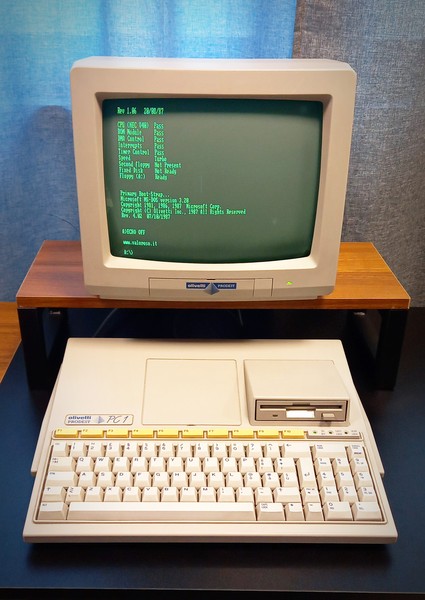
Olivetti/Prodest International introduced the PC 1 in 1987 as the third computer in its consumer Prodest range, although it was an independent Italian x86 design unrelated to the earlier PC 128 and PC 128 S platforms. Built into the keyboard enclosure, it brought MS-DOS to home and educational buyers and reached Spain with a localized manual, keyboard and system disk. It was advertised at Informat 88 for 109,000 pesetas; contemporary reporting credited Mario Bellini with its design. Italy even had a dedicated PC 1 magazine.
Hardware
- Processor
- NEC V40, switchable 4.77/8 MHz
- Memory
- 256 or 512 KB base; 640 KB through expansion
- Video
- Integrated Yamaha V6355-compatible display logic with Italian character ROM
- Floppy drive
- 3.5 in, 720 KB
- Expansion slots
- External ISA-like side connector; not a complete ISA bus
- Interfaces
- Non-standard-pinout serial, parallel, XT-style keyboard and quadrature mouse/joystick connector
Catalogue classification
- Form factor
- Desktop
- Mobility
- Stationary
- Processor generation
- 8086 class
- Storage interface
- Floppy drive
Research
This page separates documented hardware facts, behavior observed in original firmware, and the current fidelity of BluMach emulation.
Sales and commercial configurations
Evidence: documented or confirmed hardware
- Markets and period
Introduced in 1987 and sold from 1988 in Italy and other European markets. The Spanish edition is evidenced by its localized manual, keyboard and MS-DOS 3.20 disk; the base model was advertised at Informat 88 for 109,000 pesetas.
- Commercial models
The 1987 Italian reference configuration had 512 KB and one internal 3.5-inch/720 KB floppy; the manual also documents 256 KB, a second internal drive and expansion to 640 KB. PC 1 HD is a distinct 640 KB hard-disk variant, documented with 20 MB and implemented separately in BluMach as a partial emulation.
- Options and accessories
Second MF 3510 floppy, external 5.25-inch/360 KB drive, MS 1040 mouse, JO 1040 joystick, monochrome and colour monitors, and a side expansion enclosure for two short cards. RAM, network, modem, EGA, CD-ROM, hard disk, TV/telematics and music expansions were also advertised.
- Physical specifications
The 1987 Italian specification gives 39 × 34 × 8 cm, 220 V/50 Hz mains input and 35 W power consumption.
- Bundled software
The 1987 Italian package lists MS-DOS 3.20, GW-BASIC 3.20 and Lode Runner.
Architecture and memory
Evidence: documented or confirmed hardware
- CPU and bus
NEC V40 with an 8-bit external bus and BIOS-controlled 4.77/8 MHz switching. BluMach uses its NEC V20 instruction engine plus a dedicated V40 system-register, relocation and clock-control device.
- Memory
The 1987 Italian specification lists 512 KB, expandable to 640 KB only through the expansion bus; the manual also documents a 256 KB base population. All three capacities are selectable and tested in BluMach.
- Video
Internal Yamaha V6355D video with Italian character ROM 1.02 and a 50 Hz firmware default. The contemporary specification lists 80×25/40×25 text and 640×200×2, 320×200×4 and 160×200×16 graphics; BluMach models the Prodest-specific DDh/DEh interface and VRAM mirrors.
- Storage
One or two internal 3.5-inch/720 KB drives and an optional external 5.25-inch/360 KB drive. The 20 MB PC 1 HD is a distinct model with its own partial XTA implementation and creation profile.
- Serial and parallel
Italian 73-key QWERTY keyboard with separate numeric pad and 10 function keys; partially RS-232-compatible serial, Centronics parallel, audio, analog RGB/SCART, digital RGB/mono, TV and DB-9 quadrature mouse/joystick. The side connector was marketed as IBM-compatible but omits signals of a complete ISA bus.
BIOS and firmware
Evidence: documented or confirmed hardware
- Known revisions
Known system BIOS revisions 1.06, 1.07 and 1.21 are 16 KB with valid checksums; character ROM 1.01 and Italian 1.02 are 8 KB. BluMach distributes none of these bytes and identifies them only by name, size and hash.
Emulation status
Evidence: current BluMach status; not necessarily a description of the original circuit
- Verified
With BIOS 1.07, 512 KB and internal V6355 video, the initial dedicated V40 model passes resident diagnostics and boots Spanish MS-DOS 3.20. The cold-boot prompt selects normal/4.77 MHz, and Ctrl+Alt+Del preserves either normal/4.77 MHz or turbo/8 MHz while passing the next interrupt diagnostic. The 256 and 640 KB configurations and a two-drive 720 KB installation have also been tested successfully through the unified creation form.
- Pending or approximate
The V40 interrupt, timer and DMA blocks are not yet native devices; generic XT functions and the existing floppy-DMA translation remain. The serial unit is a minimal register model. The quadrature mouse and incomplete external ISA-like connector are not modelled. GUI cold reset, systematic keyboard, serial, parallel and wider software compatibility still require validation.
Sources
Preserved research material
Evidence: primary sources and research notes
- Original manual
- Installation and user manual for the Spanish edition (1987).
- Original product brochure
- Olivetti Prodest Italian commercial brochure (1987).
- Technical notes
- PC 1 Magazine, year I no. 1 (1987), page 23: contemporary Italian system specification.
- Published software
- Italian community archive of PC 1 manuals, utilities and software.
- Technical notes
- Independent historical catalogue entry for the machine.