

Olivetti · PCS
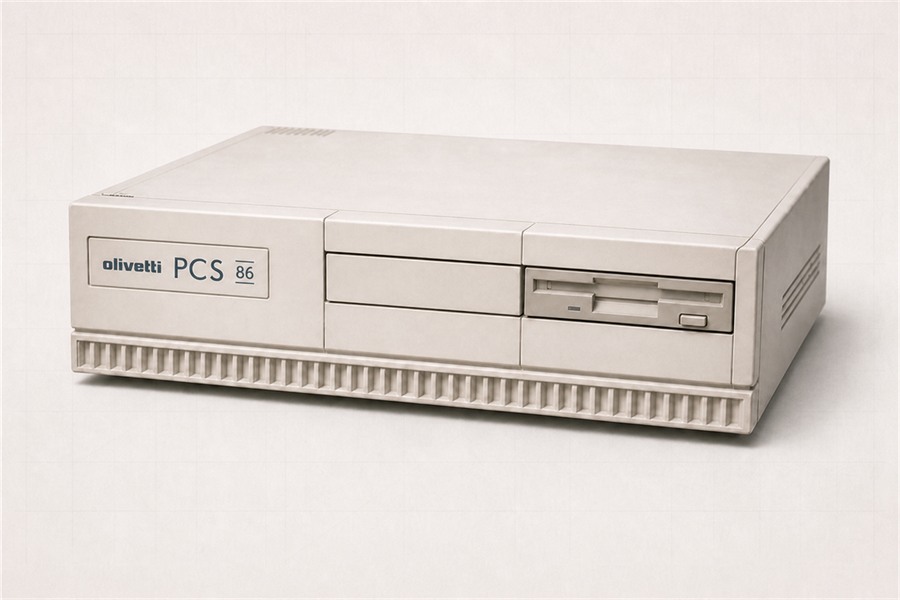
Olivetti PCS 86
Compact V30 computer with integrated VGA and unusual PS/2-style peripherals.
History
The PCS 86 is a late XT-class design combining a NEC V30, integrated VGA, an XTA hard-disk interface and two PS/2-style peripheral connections. BluMach has validated Resident Diagnostics 1.09, MS-DOS boot, EMS and a 20 MB XTA disk.
Hardware
- Processor
- NEC V30 10 MHz, 0 wait states
- Memory
- 512 KB on-board; paired SIMMs provide 640 KB conventional plus 384 or 1920 KB EMS
- Video
- Paradise VGA integrated
- Floppy drive
- 3.5 in, 720 KB
- Clock and CMOS
- MM58167
- Math coprocessor
- Intel 8087 optional
- Sound
- Optional user-installed 8-bit ISA sound card
- Expansion slots
- 3 × 8-bit full-size slots
- Interfaces
- RS-232C, bidirectional parallel, mouse, AT keyboard
- Dimensions and weight
- 360 × 312 × 100 mm; 7.6 kg
Catalogue classification
- Form factor
- Desktop
- Mobility
- Stationary
- Processor generation
- 8086 class
- Graphics standard
- VGA
- Storage interface
- Floppy drive, XTA
Research
This page separates documented hardware facts, behavior observed in original firmware, and the current fidelity of BluMach emulation.
Architecture and memory
Evidence: documented or confirmed hardware
- CPU and bus
NEC V30 at 10 MHz with zero wait states, according to the official September 1990 Olivetti brochure; 16-bit data bus with the 8-bit ISA expansion of its XT-class architecture. The PCS 86 supports software selection between approximately 7.16 and 10 MHz, based on measurements of a physical PCS 86. Check-It 3.0 on a physical unit estimates 7.18/10.02 MHz; these support nominal 7.16/10 MHz modes, without proving the electrical clock circuit. BluMach uses 10 MHz as the primary historical profile. Its emulated slow mode targets 7.20 MHz as a slightly faster compatibility choice, not a verified physical clock.
- Memory
The board provides 512 KB. Two 256 KB SIMMs complete 640 KB of conventional memory and leave 384 KB as EMS; two 1 MB SIMMs likewise complete 640 KB conventional and leave 1,920 KB as EMS. Four 16 KB windows occupy 80000h–8FFFFh.
- Video
Integrated Paradise VGA. The system BIOS also contains its initialization code, so a separate VGA option ROM at C0000h is not required.
BIOS and firmware
Evidence: behavior recovered from BIOS code and testing
- ROM organization
Two interleaved EPROMs, CSAB05 (even bytes) and CSAB04 (odd bytes), form 64 KB at F0000h–FFFFFh. The set contains system BIOS, VGA, XTA and diagnostics.
- Known revisions
Resident Diagnostics Rev. 1.09. The preserved set passes its checksum and reaches the reset vector at FFFF0h.
- Published identity
For compatibility, INT 15h/C0h identifies the system as IBM PS/2 Model 30, submodel 109. This is a firmware choice, not the computer's commercial identity.
- Resident diagnostics
Tests CPU, ROM, DMA, PIC, timer, base and expanded memory, clock/calendar, printer, communications, drives and keyboard. The observed screen is revision 1.09.
I/O port map
Evidence: documentation, reverse engineering and diagnostics
The following addresses cover PCS86-specific board logic in addition to the usual compatible blocks.
- Board control
60h–6Fh: keyboard, PIT/speaker and proprietary logic. Port 65h: bit 0 XTA, bit 1 LPT, bit 2 VGA, bit 4 COM1 and bit 7 startup/test latch according to the analyzed BIOS code.
- Keyboard and mouse
Port 60h receives keyboard scan codes and IRQ1. Ports 66h–6Ah implement the board's dual PS/2-style peripheral interface; observed IDs are AB83h for the keyboard and 00h for the mouse.
- Clock and NVRAM
E0h–EFh: MM58167 and associated NVRAM. Commands B0h–B7h manage access and status; BIOS stores date, time and checksum in its own format.
- Floppy controller
Compatible controller at 3F0h–3F7h. The physical bank selects 360 KB, 720 KB, 1.2 MB or 1.44 MB per drive with active-low combinations.
- Hard disk
XTA interface at 320h–323h, IRQ5 and DMA3. The historical 20 MB configuration is a Conner CP3026 (615 cylinders, 4 heads, 17 sectors).
- Serial and parallel
COM1 at 3F8h on IRQ4; the real diagnostics report two communications channels, while BluMach currently models the confirmed port. LPT1 is at 378h–37Fh, including special 37Ah behavior used by resident tests.
- Video
Compatible VGA registers at 3C0h–3DFh and A0000h–BFFFFh video memory. Integrated-video selection goes through board control and VGA enable logic.
- EMS memory
Page registers at 8400h–8403h; each selects the page for one of four 16 KB windows at 80000h–8FFFFh.
Jumpers and physical configuration
Evidence: behavior recovered from BIOS code and testing
- Jumper bank
Active-low port 100h: bits 0–1 drive 0 type; bits 2–3 drive 1 type; bit 7 indicates an XTA disk. Per-drive codes are 00=360 KB, 10=1.2 MB, 01=720 KB, 11=1.44 MB. Bits 4–6 are not exposed as user options because the analyzed BIOS does not consume them.
- Keyboard lock
The key/keyboard-lock state is reflected in bit 2 of port 66h.
- BluMach representation
Automatic mode derives jumpers from installed drives. Manual mode can reproduce an exact physical bank, including inconsistent settings, for research and preservation.
Emulation status
Evidence: current BluMach status; not necessarily a description of the original circuit
- Verified
BIOS and MS-DOS boot; CPU, ROM, DMA, PIC, timer, 640 KB base memory, clock/calendar, printer, keyboard and EMS diagnostics. FDISK and installation of the English edition of Windows 3.0 have also been tested on a 20 MB XTA disk.
- Pending or approximate
Electrical timing of the dual keyboard/mouse interface and some video-arbitration details remain functional approximations. Mapping the reported second communications channel still needs physical evidence.
Sources
Sources and traceability
Evidence: primary sources and research notes
- Original product brochure
- PCS 86, Olivetti Office Italia product sheet dated September 1990, 2 pages
- Technical notes
- Olivetti PCS86 technical notes by John Elliott
- Firmware and tests
- CSAB04/CSAB05 EPROMs, Resident Diagnostics 1.09, Customer Test and execution observations made during recovery.