

Olivetti · M
Olivetti M15
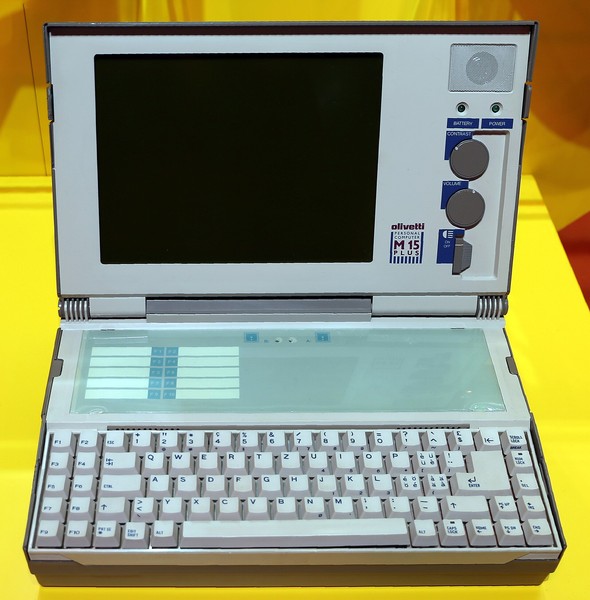
1987 80C88 portable with a detachable keyboard, two 720 KB drives and a fixed green LCD. A functional experimental model is available.
EXPERIMENTAL: the documented tests belong to the earlier pilot. This updated build still needs interactive regression testing. No add-on sound cards are supported; the internal speaker remains. Hardware approximations and unverified peripherals are described below.
History
The M15 is a distinct Olivetti portable, not an M19 or an M15 Plus. Its documented base configuration has 512 KB, two internal 3.5-inch drives and no hard disk. The fixed LCD is the machine's only display: the M15 has no external video output. BluMach runs BIOS 1.08, Resident Diagnostics and the official Starter Kit tutorial while keeping uncertain board-level behavior explicit.
Hardware
- Processor
- Intel 80C88 at 4.77 MHz
- Memory
- 256 or 512 KB system RAM; 16 KB video RAM
- Video
- Fixed green monochrome LCD driven by Yamaha V6355D-F, with no external video output. Current rendering uses four levels; the preserved specification describes six grey shades, an unresolved fidelity difference
- Floppy drive
- Two 3.5-inch, 720 KB internal drives; Matsushita JU-363 observed in a photographed example
- Clock and CMOS
- Battery-backed OKI MSM6242 clock/calendar decoded at 0100h-010Fh
- Interfaces
- RS-232C, Centronics parallel, external 5.25-inch floppy and common bus; no external video connector
- Keyboard
- Detachable 78-key keyboard with a separate controller board observed
Catalogue classification
- Form factor
- Laptop
- Mobility
- Portable
- Processor generation
- 8086 class
- Graphics standard
- CGA-compatible
- Display technology
- LCD
- Display colour
- Monochrome
- Storage interface
- Floppy drive
Research
This page separates documented hardware facts, behavior observed in original firmware, and the current fidelity of BluMach emulation.
Architecture and memory
Evidence: documented or confirmed hardware
- CPU and bus
Intel 80C88 at 4.77 MHz. The portable's board-level bus and control logic are not yet mapped.
- Options and peripherals
Documented options include a self-powered external 5.25-inch floppy unit and RS-232C/Centronics peripherals. Battery, AC supply and carrying case are accessories. Current profiles offer 256/512 KB, two internal drives and the speaker; no ISA sound cards. External floppy routing and wider peripheral support remain pending. The common-bus connector does not establish compatibility with a particular card. The guide documents upgrading 256 to 512 KB with a memory board.
- Video
Fixed green monochrome LCD, with no external video output. Text 40/80 columns and graphics 320x200/640x200 are modelled. The renderer uses four levels; the preserved manufacturer specification describes six grey shades. Their correspondence remains unresolved. Its olive background and cool blue-grey/green active pixels reuse the approved portable M15 appearance; the colours are approximate, not panel measurements.
- Jumper bank
Board switches: memory is set through the normal Machine RAM control (256 or 512 KB). The separately configurable BIOS startup switch exposes the 40- and 80-column values decoded from firmware; 80 columns is the validated default. Other reported switches remain hidden pending evidence.
- Analyzed firmware
Local BIOS 1.08 image: 64 KB container, 16 KB effective code at FC000h-FFFFFh, reset date 05/09/87 (US format MM/DD/YY: 1987-05-09). It remains local-only until provenance and rights are verified.
Emulation status
Evidence: current BluMach status; not necessarily a description of the original circuit
- Screen controls
Original controls: contrast, speaker volume and speaker ON/OFF. View → Screen controls simulates LCD contrast live; there is no backlight on this reflective panel. Colours are approximate, not calibrated. The dedicated speaker controls are not reproduced by the screen tool.
- Implementation lineage
A public engineering note covers the firmware disassembly, the diagnostics and the hypotheses that were thrown out along the way. It separates what the model reproduces from what the original board does.
- Verified
The pilot passes POST and Resident Diagnostics, boots a 720 KB M15 disk at 256 and 512 KB, supports both resets, and runs the official Starter Kit graphical tutorial. Text and both documented graphics resolutions were visually validated.
- Pending or approximate
Four green levels approximate RGBI luminance rather than the panel's physical response. BIOS supplies glyphs 00h–7Fh; 80h–FFh retain a generic CP437 fallback. Keyboard, UART, FDC and LPT use compatible devices, the RTC is a functional MSM6242 model, and Hitachi custom logic remains unmapped.
Engineering
This public engineering narrative explains how the evidence became an emulator implementation, including failures, compromises, validation and replacement criteria.
Sources
Sources and traceability
Evidence: primary sources and research notes
- Analyzed firmware
- MAME olivm15 compatibility approximation and ROM metadata
- Original product brochure
- Olivetti M15 Technical Specifications (1987)